
Last updated: January 24, 2026 | Reading time: 18 minutes
You submitted your manuscript with high hopes. Days later, you receive an email: “We regret to inform you that your manuscript has been rejected without review.”
Your heart sinks. Was your research that bad? Did you waste months of work?
Take a breath. Here’s what actually happened:
Your manuscript received a desk rejection—meaning the editor rejected it before sending it to peer reviewers. This happens to 30-50% of submissions at most journals, and 60-80% at prestigious journals like Nature or Science.
The critical insight most researchers miss: Desk rejection usually signals a journal mismatch, not research quality problems. The editor made a quick decision about fit—your work wasn’t evaluated by expert reviewers who would assess scientific merit.
Even better news: 60-70% of desk-rejected papers are eventually accepted when submitted to appropriate journals, often with minimal revisions.
This guide will help you understand what desk rejection really means, why it happened, and most importantly, what to do next to get your research published.
📊 Quick Facts About Desk Rejection:
- Timing: 3-14 days (vs. 2-4 months for peer review)
- Frequency: 30-80% of submissions, depending on the journal
- Success elsewhere: 60-70% acceptance rate at appropriate journals
- Main cause: Scope mismatch (40-50% of cases)
- What it means: Wrong journal fit, not bad research
In this guide:
- What Is Desk Rejection?
- 7 Main Reasons
- What to Do After Desk Rejection
- Desk Rejection vs Post-Review
- FAQ
What Does Desk Rejection Mean?
Desk rejection (also called editorial rejection) means a journal editor rejected your manuscript before sending it for peer review—typically within 3-14 days of submission.
What it signals:
- Not: Your research is of bad quality
- Usually: Journal mismatch or scope/fit issues
- Success rate elsewhere: 60-70% of desk-rejected papers are accepted at other journals
Most common reasons:
- Scope mismatch (40-50% of cases)
- Doesn’t fit the journal’s current editorial priorities
- Poor manuscript preparation (formatting, writing quality)
- Weak literature framing or unclear contribution
What to do next:
- Read the decision letter for specific reasons
- Identify 3-5 better-fit journals (check their recent issues)
- Resubmit within 2-4 weeks with minimal revisions
- Expected outcome: Acceptance at an appropriate journal
Timeline advantage: Desk rejection saves time—you get a decision in days instead of waiting 2-4 months for peer review, then getting rejected.
Read on for: Detailed reasons, how to prevent it, and strategic resubmission guidance.
Desk Rejection vs. Post-Review Rejection (Key Differences)
| Aspect | Desk Rejection | Post-Review Rejection |
|---|---|---|
| Timeline | 3-14 days | 2-4 months |
| Who decides | Editor only | Editor + 2-3 reviewers |
| Main reason | Scope/fit mismatch | Methodology/results quality |
| Feedback detail | Minimal (1-2 sentences) | Detailed reviewer comments |
| What it means | “Wrong journal” | “Needs fundamental changes” |
| Success elsewhere | 60-70% acceptance rate | 30-40% acceptance rate |
| Revisions needed | Usually minimal | Often substantial |
Key insight: Desk rejection is often easier to overcome than post-review rejection because it’s a targeting problem, not a quality problem.
What Is Desk Rejection? (Definition & Timeline)
Desk rejection (also called editorial rejection or administrative rejection) occurs when a journal editor rejects your manuscript before sending it for external peer review. This decision typically happens within 1-7 days of submission.
Quick Facts:
- Timing: 3-14 days (vs. 2-4 months for peer review)
- Who decides: Editor only (no reviewers involved)
- Feedback: Usually minimal—often just 1-2 template sentences
- Success elsewhere: 60-70% of desk-rejected papers are accepted at other journals
Important: Desk rejection does NOT mean your research is bad. It typically indicates a mismatch between your paper and the journal’s scope or priorities—not a flaw in your scientific work.
Desk Rejection Meaning: Why It Happens (7 Main Reasons)
As a research engineer who reviews manuscripts for multiple journals and has experienced desk rejections firsthand, I’ve learned that these decisions follow predictable patterns. More importantly, they’re often the easiest type of rejection to prevent with proper targeting and preparation.
The Editorial Workflow
Understanding where desk rejection fits in the submission process:
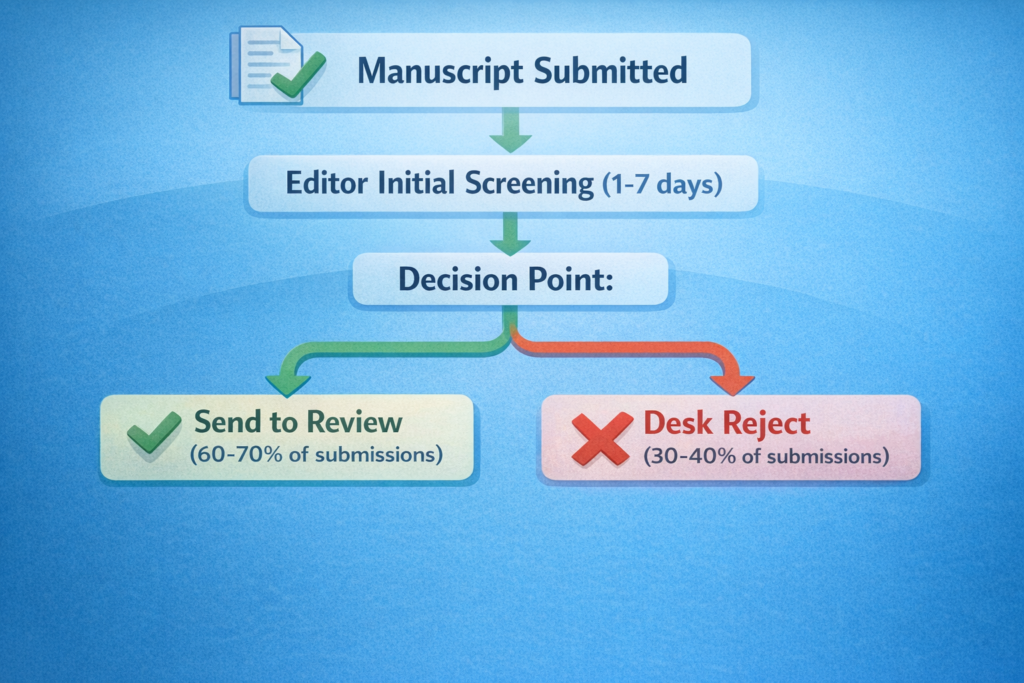
The editor’s perspective: Before involving 2-3 expert reviewers who volunteer their time, editors ask: “Does this manuscript have a realistic chance of acceptance at our journal?”
If the answer is clearly no due to scope, fit, or preparation issues, desk rejection saves everyone’s time.
7 Main Reasons Editors’ Desk Reject Papers
At a glance:
- Scope mismatch (40-50% of cases) ← Most common
- Lack of fit with editorial priorities
- Poor manuscript preparation
- Weak or generic literature framing
- Insufficient or unclear contribution
- Ethical or compliance concerns
- Wrong article type or format
Let’s explore each in detail:
1. Scope Mismatch (Most Frequent Cause)
The problem: The manuscript doesn’t fit the journal’s aims, audience, or thematic priorities.
A specialized engineering methods paper focused on computational fluid dynamics was submitted to a journal that primarily publishes energy policy and economics research. The research might be excellent, but the readership wouldn’t engage with it.
What editors look for:
- Does this topic appear in our recent issues?
- Would our readers find this relevant?
- Does the framing match our journal’s focus (theory vs. application, fundamental vs. practical)?
How to avoid this: Before submitting, review at least 10 recent articles from the journal and ask:
- Do they use similar methods?
- Do they address similar research communities?
- Is the level of technical detail comparable?
- Are the research questions framed similarly?
The pattern I’ve observed as a reviewer: Scope mismatches represent roughly 40-50% of desk rejections. These are the most preventable rejections—they happen when authors skip proper journal selection.
2. Lack of Fit With Editorial Priorities
Editors balance each issue’s content mix across:
- Topic variety – Can’t publish five battery papers in one issue
- Methodological diversity – Need a mix of experimental, computational, and theoretical work
- Geographic representation – Some journals seek a global perspective
- Reader appeal – Must maintain subscriber interest
Even strong papers may not fit a journal’s current priorities or recent publication patterns.
Example scenario: A journal focusing on renewable energy systems may desk reject an excellent paper on fossil fuel combustion optimization—not because the work is weak, but because it conflicts with the journal’s strategic direction toward sustainability topics.
Strategic insight: Journal priorities shift over time. A topic that was popular 2-3 years ago might no longer align with the current editorial focus. Check the most recent 12 months of publications, not just the journal’s general scope statement.
3. Poor Manuscript Preparation
Some desk rejections occur because the paper signals it isn’t ready for peer review:
Common preparation issues:
- Poor formatting – Doesn’t follow journal template or style guidelines
- Missing key sections – Incomplete abstract, methods, or results
- Unclear writing – Language quality prevents understanding of the contribution
- Incomplete references – Missing DOIs, incorrect citations, outdated formatting
- Low-quality figures – Illegible labels, poor resolution, no captions
- Excessive length – Far exceeds word limits without justification
These issues signal to editors: “The authors haven’t invested enough effort to make this ready for expert review.”
When I receive poorly prepared manuscripts to review, my evaluation starts with a negative bias. Editors protect reviewers from this by desk-rejecting obvious preparation failures.
Use pre-submission checklists provided by many journals. Most major publishers (Elsevier, Springer, Wiley) provide detailed author guidelines with checklists covering:
- Formatting requirements
- Section structure
- Figure specifications
- Reference style
- Ethical compliance documentation
4. Weak or Generic Literature Framing
Editors look for manuscripts that:
- Show awareness of recent developments – Cite papers from the last 2-3 years
- Clearly position themselves in ongoing debates – Identify specific gaps
- Demonstrate a clear, non-obvious contribution – Go beyond “this hasn’t been done before.”
Red flags that trigger desk rejection:
- Literature review cites only papers older than 5 years
- No engagement with contradictory findings or competing approaches
- Generic gap statement like “more research is needed” without specificity
- Failure to cite obvious recent work (especially from the target journal)
What this signals to editors: The authors aren’t sufficiently engaged with the current state of the field, suggesting the work may be outdated or poorly contextualized.
The strategic mistake many authors make: They write a comprehensive historical literature review but fail to engage with the most recent 18-24 months of publications. Editors notice this immediately.
5. Insufficient or Unclear Contribution
Beyond literature framing, editors assess whether the manuscript’s contribution is:
- Novel – Genuinely new findings or approaches
- Significant – Advances understanding or practice meaningfully
- Clear – Articulated explicitly, not buried in results
- Appropriate for the journal’s scope – Matches the level of impact expected
Desk rejection occurs when:
- The contribution is too incremental for the journal’s standards
- The advance over existing work is unclear or poorly explained
- The framing emphasizes effort (“we built a complex model”) rather than insight (“we discovered that X causes Y”)
The contribution test: Can you summarize in 1-2 sentences what readers will know after your paper that they didn’t know before? If this is unclear to you, it will be unclear to editors.
6. Ethical or Compliance Concerns
Editors may desk reject immediately if:
- Plagiarism detected – Software flags similarity with published work
- Ethical approvals missing – Human subjects or animal research without IRB approval
- Submission guidelines violated – Duplicate submission, word count exceeded drastically
- Authorship concerns – Author list changes without documentation
- Conflicts of interest undisclosed – Funding or commercial relationships hidden
Why editors don’t negotiate on ethics: These are non-discretionary. Journals follow strict ethical guidelines from organizations like COPE (Committee on Publication Ethics), and violations result in automatic rejection without discussion.
The consequences extend beyond one paper: Ethical violations can result in:
- Blacklisting from the journal
- Notification to authors’ institutions
- Public retraction if discovered post-publication
- Damage to long-term publishing credibility
Why Some Editors Provide Little or No Feedback
Many desk rejection notices are frustratingly brief—sometimes only a sentence or two:
“After careful consideration, we have determined that your manuscript does not fit within the scope of our journal. We wish you success in placing it elsewhere.”
This minimal feedback reflects several factors:
Workflow Efficiency
Editors receive hundreds of submissions monthly and must prioritize reviewer time and editorial resources. Writing detailed feedback for every desk rejection would be unsustainable.
Policy or Practice Variations
Some journals never provide detailed reasons unless required by institutional policies. Others provide slightly more guidance for a subset of desk rejections.
Avoiding Unnecessary Debate
Detailed explanations can invite authors to argue about scope or fit decisions, creating unproductive back-and-forth. Editors prefer to make clean decisions and move forward.
Protection of Editorial Judgment
Editors don’t want to appear to be making scientific judgments without peer review. Scope and fit decisions are editorial prerogatives that don’t require scientific justification in the same way reviewer comments do.
While unhelpful for authors, this minimal feedback is standard practice across most journals. The lack of detail doesn’t mean your paper is terrible—it means the editor made a quick decision based on high-level criteria.
Desk Rejection vs. Post-Review Rejection: Key Differences
Understanding the difference helps you respond strategically:
| Aspect | Desk Rejection | Post-Review Rejection |
|---|---|---|
| Timeline | 3-14 days | 2-4 months |
| Who decides | Editor only | Editor + 2-3 peer reviewers |
| Reason | Usually, scope/fit issues | Usually methodology or results quality |
| Feedback detail | Minimal (1-2 sentences) | Detailed reviewer comments |
| What it means | “Wrong journal for this paper.” | Find a better-fit journal, with minimal changes |
| Resubmission strategy | Find better-fit journal, minimal changes | Major revisions before resubmitting |
| Success rate elsewhere | 60-70% | 30-40% |
Key insight: Desk rejection is often easier to overcome than post-review rejection because it indicates targeting problems rather than fundamental research flaws.
Decision Tree: What to Do After Desk Rejection
Step 1: Did the editor provide specific reasons?
→ YES (reasons given):
- Scope mismatch → Find a journal where your topic appears in recent issues
- Preparation issues → Fix formatting/writing before resubmitting
- Ethical concerns → Address compliance issues before resubmitting
- Unclear contribution → Revise abstract and introduction to clarify
→ NO (generic rejection letter):
- Assume scope mismatch (most common reason)
- Review the journal’s recent 12 months of publications
- Ask: Does my topic appear 3+ times? If no → wrong journal
- Select a new journal where your topic is clearly represented
Step 2: Does your manuscript need revisions?
→ Minimal/None (scope mismatch only):
- Resubmit within 1-2 weeks
- Update cover letter for new journal
- Adjust formatting to the new journal’s style
→ Some revisions needed:
- Fix preparation issues (2-4 weeks)
- Update literature review if needed
- Clarify the contribution statement
- Resubmit within 3-4 weeks
Step 3: Select a better-fit journal:
- Identify 3-5 journals with recent articles on your topic
- Rank by topical fit first, prestige second
- Check editorial priorities (recent editorials, special issues)
- Submit to the best-fit journal
Expected timeline: Under review at new journal within 1 month (vs. 3-4 months lost if you’d waited for peer review)
Quick Action Plan (First 48 Hours)
Day 1:
- Read the decision letter carefully for any specific reasons
- Don’t take it personally—this is about fit, not quality
- Review the journal’s recent publications to confirm the mismatch
Day 2-3:
- Decide if your manuscript needs any revisions (usually minimal)
- Identify 3-5 better-fit journals using the criteria below
- Prepare your resubmission plan
Within 2-4 weeks:
- Submit to a better-matched journal
- Update your cover letter to emphasize fit with the new journal
Expected outcome: 60-70% of desk-rejected papers are accepted when submitted to an appropriate journal.
Detailed Steps for Strategic Resubmission
Step 1: Review the Journal’s Scope Critically
Ask yourself honestly:
- Did I choose the right venue?
- Are the journal’s recent publications aligned with my topic?
- Did I just target this journal because of the impact factor?
- Was this a “stretch” submission, hoping for the best?
Common pattern in desk rejections: Authors target journals based on prestige rather than fit, hoping editorial decisions will go their way. Editors see through this immediately.
The best approach is to identify 3-5 journals where your topic actually appears regularly in recent issues. Rank them by fit first and then prestige second.
Step 2: Improve Key Sections Before Resubmitting
Focus revision effort on:
Title and Abstract
- Does the title clearly indicate the topic and contribution?
- Does the abstract explicitly state novelty and significance?
- Are keywords optimized for the new target journal?
Introduction and Literature Review
- Updated with the most recent 18-24 months of citations?
- Clearly positions the research gap?
- Engages with contradictory or competing approaches?
Explicit Contribution Statement: Add a paragraph near the end of the introduction that explicitly states:
- What this paper contributes
- Why it matters
- Who should care
Many successful resubmissions after desk rejection involve minimal content changes but substantial improvements to framing and positioning.
Step 3: Consider a Better-Matched Journal
Don’t just submit to “the next journal down” in prestige. Find a genuine topical fit.
Strategic journal selection:
- Identify journals that have published similar work recently
- Look for special issues or topical collections in your area
- Consider newer journals establishing themselves in your field (often more receptive)
- Evaluate regional or specialized journals with focused audiences
The resubmission timeline advantage: Starting over at a well-matched journal often results in faster publication than trying to force fit at a prestigious but inappropriate venue.
Differentiating Desk Rejection From Other Outcomes
Understanding where desk rejection fits in the spectrum of editorial decisions helps contextualize the experience:
| Decision Type | Meaning | What It Implies | Typical Timeline |
|---|---|---|---|
| Desk Rejection | No external review | Editor sees fit or readiness issues | 3-14 days |
| Reject After Review | Reviewed by experts | Content concerns at a deeper level | 2-4 months |
| Major Revision | Reviewers see potential | Content issues can be addressed | 2-4 months |
| Revise & Resubmit | Opportunity to improve | Strong potential with effort | 2-4 months |
| Minor Revision | Nearly acceptable | Small changes needed | 2-4 months |
| Accept | Ready for publication | Meets all standards | 2-4 months |
Key insight: Desk rejection actually indicates you haven’t failed peer review—you haven’t entered it yet. This distinction matters because:
- No reviewers have judged your research quality
- The scientific merit wasn’t questioned
- The decision was administrative/editorial, not scientific
- You can often resubmit the same work elsewhere with minimal changes
Desk rejection is often easier to overcome than post-review rejection because it typically requires better targeting rather than fundamental research improvements.
Understanding Desk Rejection Rates Across Fields
Desk rejection frequency varies significantly by:
By Discipline
- High-impact multidisciplinary journals (Nature, Science): 60-80% desk rejection rate
- Top-tier specialized journals: 40-60% desk rejection rate
- Mid-tier field-specific journals: 20-40% desk rejection rate
- Society journals with member focus: 10-25% desk rejection rate
By Journal Strategy
- Journals’ increasing impact factor: Higher desk rejection rates (rejecting broadly, accepting narrowly)
- Journals building community: Lower desk rejection rates (encouraging diverse submissions)
- New journals establishing reputation: Variable rates depending on submission volume
What this means for you: A desk rejection from a highly selective journal is statistically normal and doesn’t reflect poorly on your work. Many excellent papers are desk-rejected from Nature or Science but published successfully in strong specialized journals.
Can You Appeal a Desk Rejection?
Short answer: Rarely successful, but possible in specific circumstances.
When to Consider an Appeal
Appeals might succeed if:
- The editor made a factual error about your manuscript’s content
- Recent changes to the journal scope actually do include your topic
- You can cite very recent articles from the journal on your exact topic
- The decision letter contradicts the journal’s stated aims and scope
When NOT to Appeal
Appeals rarely succeed when based on:
“My research is high quality” (not the issue)
“I spent a lot of time on this” (not relevant to fit)
“Other journals have rejected it too” (doesn’t strengthen your case)
“I disagree with your assessment” (editor’s decision is final)
How to Appeal Professionally (If Warranted)
Structure:
- Brief, respectful opening – Thank the editor for their time
- Specific factual basis – Cite recent journal articles on your topic
- Clear request – Ask for reconsideration, not a complaint
- New information – Provide evidence the editor may have missed
- Acceptance of alternative – Acknowledge their decision is final
Keep it under 250 words. Long appeals are ignored.
Success rate: Approximately 5-10% of appeals result in reconsideration. Only appeal if you have genuinely new information or can demonstrate a clear editor error.
Real Author Experiences and Common Questions
Based on editorial practices and author discussions on platforms like ResearchGate and academic forums, common questions include:
“Why reject without detailed reasons?”
The editorial perspective: Editors assume that high-level decisions (scope, fit, readiness) are best handled by the author’s understanding of the journal context rather than a detailed explanation.
This is workflow-driven rather than quality-judgment driven. Providing detailed feedback for every desk rejection would require editors to spend hours daily writing rejection rationales when the core issue is often simply: “This doesn’t fit our journal.”
“Should I contact the editor for feedback?”
General advice: Polite, brief inquiries are acceptable, but set realistic expectations:
Acceptable inquiry example:
“Thank you for your editorial decision. To help me select a more appropriate venue, could you briefly clarify whether the rejection was primarily due to scope, methodological approach, or another factor? I appreciate any guidance you can provide.”
Typical editor response:
“The decision was based on scope fit. We recommend considering journals that focus on [specific area]. Best wishes for publication.”
When NOT to contact:
- To argue about the decision
- To ask them to reconsider
- To complain about the lack of feedback
- To explain why they’re wrong
“Does desk rejection damage my reputation?”
No. Desk rejections are:
- Not tracked publicly
- Not visible to other journals
- Not reported to institutions
- Not considered “failures” in any formal sense
Your publication record includes only accepted papers. Desk rejections leave no trace.
Strategies to Prevent Desk Rejection
Pre-Submission Checklist
Before submitting, verify:
- [ ] I have read 10+ recent articles from this journal
- [ ] My topic appears in the journal regularly (at least 3-5 times in the past 2 years)
- [ ] My methodology matches what they typically publish
- [ ] The framing (theory vs. application) aligns with their style
- [ ] My manuscript follows their formatting guidelines exactly
- [ ] My title and abstract clearly state the contribution and fit
- [ ] My literature review includes recent papers from this journal
- [ ] All ethical compliance documents are included
- [ ] I’ve had someone outside my research group read the abstract for clarity
Strategic tip: If you can’t check most of these boxes, you’re submitting to the wrong journal.
The Journal Selection Matrix
Create a comparison table for your top 3-5 journal choices:
| Criteria | Journal A | Journal B | Journal C |
|---|---|---|---|
| Topic fit (1-10) | |||
| Method fit (1-10) | |||
| Recent similar papers | |||
| Avg time to decision | |||
| Impact factor | |||
| Total fit score |
Submit to the highest “total fit score,” not the highest impact factor.
Frequently Asked Questions About Desk Rejection
Is desk rejection common?
Yes, very common. Desk rejection rates range from 30-50% at mid-tier journals to 60-80% at highly selective journals like Nature or Science. Even experienced researchers with strong track records receive desk rejections regularly when the targeting doesn’t match.
Can I appeal a desk rejection?
Rarely successful (5-10% success rate) unless you can demonstrate:
- Factual error in the editor’s assessment
- Recent journal articles on your exact topic, they may have missed
- Clear contradiction with the stated journal scope
Don’t appeal based on research quality—editors know that’s not the issue.
Does desk rejection affect my academic record?
No. Desk rejections are:
- Not tracked publicly
- Not visible to other journals
- Not reported to your institution
- Not considered “failures” in any evaluation process
Should I revise my manuscript before resubmitting?
Usually, minimal changes are needed:
- If scope mismatch: No content changes, just target a better journal
- If preparation concerns are mentioned: Fix formatting/writing issues
- If no reason given: Manuscript is likely fine as-is
Focus your effort on selecting the right journal rather than major revisions.
How long does it take to recover from desk rejection?
Timeline advantage: Desk rejection actually saves you time:
- Get decision in 1-7 days (vs. 2-4 months for peer review)
- Resubmit within 2-4 weeks
- Can be under review at a better-fit journal within 1 month
Compare this to post-review rejection, which requires months of review time plus major revisions.
Why do editors provide so little feedback?
Editors handle hundreds of submissions monthly. Writing detailed feedback for every desk rejection would be unsustainable. The minimal feedback reflects:
- Workflow efficiency needs
- Scope decisions are editorial prerogatives (don’t require scientific justification)
- Avoiding unproductive debates about fit
The lack of detail doesn’t mean your paper is terrible—it means the decision was straightforward from an editorial perspective.
Frequently Asked Questions About Desk Rejection
What does desk rejection mean?
Desk rejection means a journal editor rejected your manuscript before sending it for external peer review, typically within 3-14 days of submission. It usually indicates a mismatch between your paper and the journal’s scope or priorities—not a fundamental flaw in your research. 60-70% of desk-rejected papers are accepted when submitted to appropriate journals.
Is desk rejection common?
Yes, very common. Desk rejection rates range from 30-50% at mid-tier journals to 60-80% at highly selective journals like Nature or Science. Even experienced researchers with strong publication records receive desk rejections regularly when targeting doesn’t match journal scope.
What’s the difference between desk rejection and regular rejection?
Desk rejection happens before peer review (3-14 days, editor only, minimal feedback, usually scope/fit issues). Regular rejection happens after peer review (2-4 months, includes detailed reviewer comments, indicates content quality concerns). Desk rejection is often easier to overcome—just find a better-fit journal.
Can you resubmit a desk-rejected paper?
Yes, absolutely. 60-70% of desk-rejected papers are eventually accepted when submitted to appropriate journals. Usually minimal revisions are needed—focus on selecting a journal where your topic actually appears in recent issues rather than major content changes. You can typically resubmit within 2-4 weeks.
Does desk rejection mean my research is bad?
No. Desk rejection indicates targeting or fit issues, not research quality. Your work wasn’t evaluated by expert peer reviewers—the editor made a quick decision about journal fit. The scientific merit wasn’t questioned. Many excellent papers get desk rejected from prestigious journals but publish successfully in well-matched journals.
How long does desk rejection take?
Desk rejection typically occurs within 3-14 days of submission, though some journals decide within 24-48 hours. This is much faster than the 2-4 months required for full peer review, which means you can resubmit to a better-fit journal quickly rather than wasting months waiting.
Should I appeal a desk rejection?
Rarely successful (5-10% success rate) unless you can demonstrate a factual error or cite very recent articles from the journal on your exact topic. Don’t appeal based on research quality—that’s not why you were desk rejected. Better to spend time selecting an appropriate journal for resubmission.
What are the main causes of desk rejection?
The 7 main causes are: (1) Scope mismatch (40-50% of cases)—your topic doesn’t fit the journal, (2) Doesn’t align with editorial priorities, (3) Poor manuscript preparation, (4) Weak literature framing, (5) Unclear contribution, (6) Ethical/compliance concerns, (7) Wrong article format. Scope mismatch is by far the most common and most preventable.
Can desk rejection affect my academic reputation?
No. Desk rejections are not tracked publicly, not visible to other journals, not reported to your institution, and not considered “failures” in any evaluation process. Your publication record includes only accepted papers. Desk rejections leave no trace and happen to all researchers.
How do I avoid desk rejection?
Read 10+ recent articles from the target journal before submitting. Verify your topic appears regularly in their issues, your methodology matches theirs, and your framing aligns with their style. Follow formatting guidelines exactly. Clearly state your contribution in the abstract and introduction. Cite recent papers from the journal. Select journals based on topical fit first, prestige second.
Key Takeaway: Desk Rejection Is a Targeting Problem, Not a Quality Problem
Desk rejection is a practical editorial filter, not a judgment of research worth. It helps journals manage limited reviewer resources and maintain thematic focus.
The strategic perspective:
- Desk rejections happen quickly (saving you time)
- They indicate targeting issues, not scientific flaws
- They’re often easier to overcome than post-review rejection
- They provide an opportunity to find a better-matched journal
By improving your approach, you can dramatically reduce desk rejection rates:
- Select journals where your topic appears regularly
- Refine your framing to match journal style and priorities
- Clearly articulate relevance and contribution
- Follow formatting and preparation guidelines meticulously
- Engage with recent literature from your target journal
Most importantly: Don’t take desk rejection personally. Even experienced researchers with strong publication records receive desk rejections regularly when they target inappropriately or submit work that doesn’t align with a journal’s current priorities.
The goal isn’t to avoid all desk rejections—it’s to submit strategically so your well-prepared manuscripts reach peer review at journals where they genuinely fit.
Related Resources
Understanding Other Journal Decisions:
Pingback: Journal Editorial Decision Process Explained Clearly
Pingback: How Journal Editors Make Decisions: An Insider's View - ije2.com
Pingback: What to Do After Manuscript Rejection: Complete Guide (2026) - ije2.com
Pingback: How to Appeal a Journal Rejection: When It Works (5-10%) - ije2.com